TNPCB Environmental Clearance: Timeline, Documents, Fees and Process Explained
Starting an industrial, manufacturing, construction, or infrastructure project in Tamil Nadu may require environmental approvals. Depending on the nature and scale of the project, businesses may need Environmental Clearance (EC) and approvals from the Tamil Nadu Pollution Control Board (TNPCB).
Understanding the process, documents, timeline, and fees can help businesses avoid unnecessary delays and compliance issues.
What Is TNPCB Environmental Clearance?
Environmental Clearance is a regulatory approval required for certain projects that may have an impact on the environment. The requirement depends on factors such as project type, size, location, capacity, and applicable environmental regulations.
TNPCB also regulates pollution from industries and certain other activities through approvals such as:
- Consent to Establish (CTE) – generally required before establishing applicable industrial activities.
- Consent to Operate (CTO) – generally required before operating applicable facilities after the required infrastructure and pollution-control systems are in place.
Environmental Clearance and TNPCB Consent are different approvals, and a project may require one or both depending on its specific requirements.
TNPCB Environmental Clearance Process
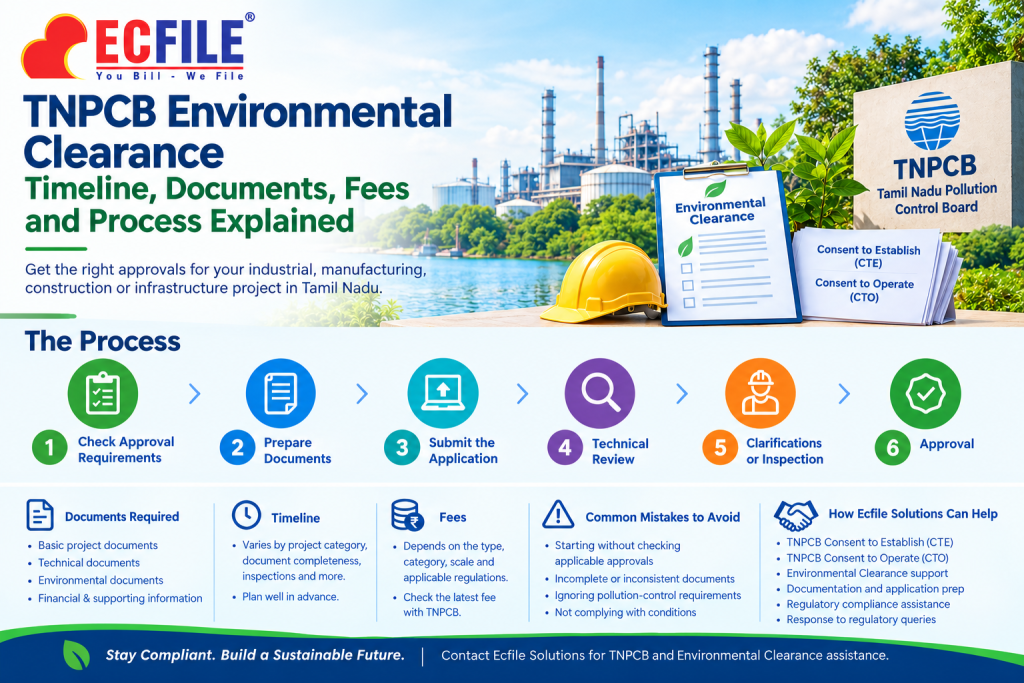
The general process may include:
1. Check Approval Requirements
Determine whether the project requires Environmental Clearance, TNPCB CTE, CTO, or other environmental approvals.
2. Prepare Documents
Collect the project, technical, financial, land, and environmental information required for the application.
3. Submit the Application
Submit the application through the applicable regulatory portal along with supporting documents and applicable fees.
4. Technical Review
The concerned authority reviews the project details, pollution-control measures, environmental impacts, and other applicable requirements.
5. Clarifications or Inspection
Additional information or a site inspection may be required depending on the project.
6. Approval
After completing the applicable review, the relevant approval may be issued with conditions that the project must follow.
Documents Required for TNPCB and Environmental Approvals
The exact document list varies according to the type of project and approval. Common documents may include:
Basic Project Documents
- Applicant/company details
- Identity and address proof
- Company registration documents
- Land ownership or lease documents
- Site plan
- Project layout
- Location map
- Project report
Technical Documents
- Manufacturing process details
- Raw-material details
- Product details
- Production capacity
- Water balance
- Material balance
- Power requirement
- Process flow diagram
- Equipment details
Environmental Documents
- Wastewater generation details
- Effluent-treatment system details
- Air-emission details
- Air-pollution-control measures
- Solid-waste management plan
- Hazardous-waste details, where applicable
- Sewage treatment arrangements
- Environmental management plan, where applicable
Financial and Supporting Information
- Project cost
- Applicable fee details
- Previous environmental approvals, if any
- Previous TNPCB consents, where applicable
- Compliance reports, where applicable
- Other supporting certificates or documents required for the specific project
The final document checklist should always be prepared based on the specific project and applicable regulatory requirements rather than relying on a generic list.
How Long Does the Process Take?
There is no single fixed timeline for every TNPCB or Environmental Clearance application. Processing time can depend on the project category, completeness of documents, technical evaluation, inspections, additional studies, queries, and other regulatory requirements.
Businesses should therefore begin the approval process well before the planned project commencement date.
What Are the Fees?
TNPCB and Environmental Clearance fees vary depending on the type of approval, project category, scale, investment, and applicable regulatory requirements.
Since fee structures can change, businesses should verify the current applicable fee before submitting an application.
Common Mistakes to Avoid
Businesses should avoid:
- Starting activities without checking applicable approvals
- Submitting incomplete documents
- Providing inconsistent project information
- Ignoring pollution-control requirements
- Failing to comply with approval conditions
Proper planning and documentation can help make the approval process more efficient.
How Ecfile Solutions Can Help
Ecfile Solutions assists businesses with environmental compliance and regulatory documentation in Tamil Nadu. Our services can include:
- TNPCB Consent to Establish
- TNPCB Consent to Operate
- Environmental Clearance support
- Documentation and application preparation
- Regulatory compliance assistance
- Support for responding to regulatory queries
Conclusion
TNPCB and Environmental Clearance requirements depend on the specific nature and scale of a project. Understanding the applicable approvals, documents, fees, and process at the planning stage can help businesses maintain regulatory compliance and avoid delays.
Planning a project in Tamil Nadu? Contact Ecfile Solutions for assistance with TNPCB and Environmental Clearance requirements.
Frequently Asked Questions
Is Environmental Clearance mandatory for every industry?
No. Environmental Clearance is applicable to projects and activities covered by the relevant environmental regulations. Applicability depends on the project’s characteristics, location, size, and other prescribed criteria.
Is TNPCB Consent the same as Environmental Clearance?
No. They are separate regulatory requirements with different purposes. Depending on the project, both may be applicable.
Can I start construction before getting Environmental Clearance?
Businesses should determine the applicable regulatory requirements before starting project activities. Where Environmental Clearance is mandatory, the project must comply with the applicable requirements before undertaking activities restricted by the relevant regulations.
How long does TNPCB approval take?
The timeline varies according to the type of application, project category, completeness of documentation, technical review, inspections, queries, and other regulatory requirements.
How much does TNPCB approval cost?
The applicable fee depends on the type and category of the application and other parameters prescribed by TNPCB. Applicants should verify the current fee applicable to their specific project before filing.
What documents are required?
The documents depend on the project and approval type. Common requirements include project details, land documents, site plans, process information, water and waste details, pollution-control measures, and financial/project information.