
Tax Audit Filing in India: Who Needs to File, Types of Tax Audit and How to Download Form 3CB & 3CD
Tax Audit is an important compliance requirement under the Income Tax Act for certain businesses and professionals. It helps ensure that books of accounts are properly maintained and that financial and tax-related information is correctly reported to the Income Tax Department.
For FY 2025–26 (AY 2026–27), taxpayers covered under the tax audit provisions continue to use Form 3CA-3CD or Form 3CB-3CD, depending on whether their accounts are already required to be audited under another law.
What is Tax Audit?
A Tax Audit is an examination of the books of accounts of a taxpayer by a Chartered Accountant to verify and report prescribed financial and tax information to the Income Tax Department.
The requirement was introduced under Section 44AB of the Income Tax Act, 1961. The audit report contains information regarding turnover, expenses, depreciation, deductions, tax payments and other particulars relevant for determining taxable income.
The objective of a tax audit is to:
- Ensure proper maintenance of books of accounts
- Verify financial information reported by the taxpayer
- Identify discrepancies and reporting requirements
- Ensure compliance with provisions of the Income Tax Act
- Help the Income Tax Department assess taxable income correctly
Who Needs to File Tax Audit?
Tax audit is generally applicable to persons carrying on a business or profession when the prescribed conditions under the Income Tax Act are satisfied.
1. Businesses
For a business, tax audit is generally applicable when total sales, turnover or gross receipts exceed:
₹1 crore
However, the threshold is increased to ₹10 crore where cash receipts and cash payments do not exceed the prescribed 5% limit.
Therefore, businesses with turnover above the applicable threshold should examine whether they are required to obtain a tax audit report.
2. Professionals
For persons carrying on specified professions, tax audit is generally applicable when gross receipts exceed:
₹50 lakh
Professionals should also consider the specific provisions applicable to their profession and method of taxation.
3. Persons Opting Out of Presumptive Taxation
Tax audit can also become applicable to certain taxpayers who are covered by presumptive taxation provisions but declare income below the prescribed limits or opt out of the presumptive taxation scheme.
Therefore, merely looking at turnover is not always sufficient. The taxpayer’s business/profession, income declared and taxation scheme should also be examined.
Different Types of Tax Audit Forms
There are two principal tax audit report combinations for FY 2025–26:
Form 3CA + Form 3CD
Form 3CA-3CD applies where the taxpayer is already required to get the accounts audited under another law.
For example, where accounts are subject to statutory audit under another applicable law, Form 3CA is used along with Form 3CD.
Form 3CA contains the audit report, while Form 3CD contains the detailed statement of prescribed particulars.
Form 3CB + Form 3CD
Form 3CB-3CD applies where the taxpayer is required to obtain a tax audit under the Income Tax Act but is not required to get the accounts audited under any other law.
Form 3CB contains the audit report and Form 3CD contains the detailed particulars required under the Income Tax Act.
Quick Comparison
| Situation | Applicable Form |
| Accounts audited under another law | Form 3CA + 3CD |
| Accounts not audited under another law but tax audit is applicable | Form 3CB + 3CD |
Only one of these two combinations will generally apply to a taxpayer for the relevant tax audit requirement.
What is Form 3CD?
Form 3CD is a detailed statement of particulars that accompanies the tax audit report.
It contains various financial and tax-related details, including information relating to:
- Nature of business or profession
- Books of accounts maintained
- Turnover and gross receipts
- Accounting methods
- Depreciation
- Loans and specified transactions
- Disallowable expenses
- GST-related information where applicable
- Deductions and other tax provisions
- Payments and statutory compliance
- Other prescribed particulars
The Chartered Accountant verifies the information and reports the applicable particulars in Form 3CD.
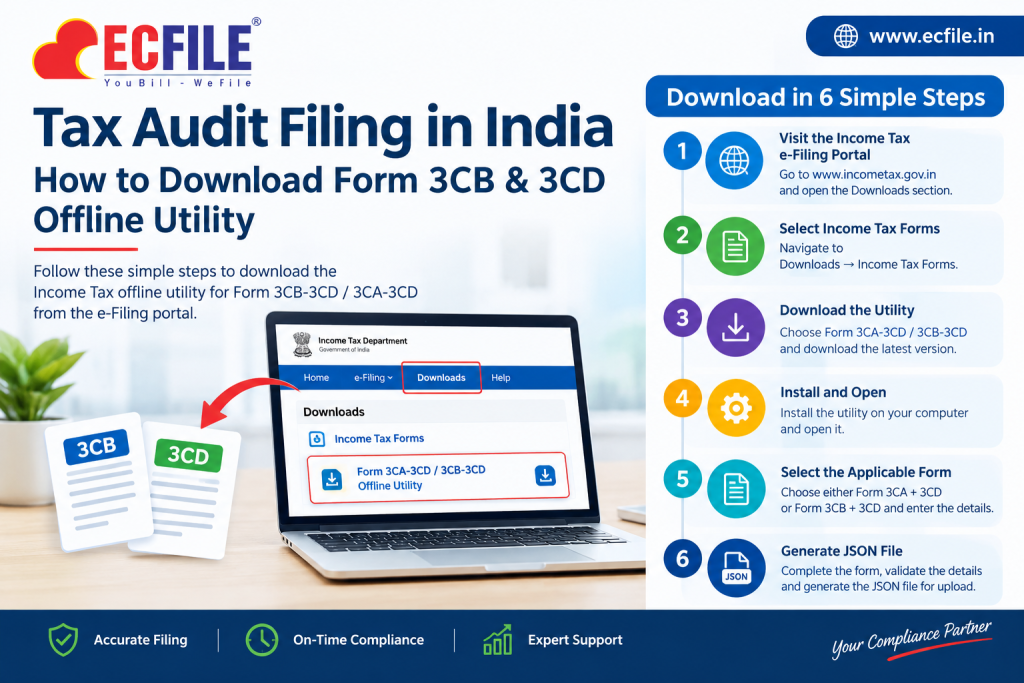
How to Download Form 3CB & 3CD Offline Utility?
The Income Tax Department provides an offline utility for preparing Form 3CA-3CD and Form 3CB-3CD.
Step 1: Visit the Income Tax e-Filing Portal
Go to the official Income Tax e-Filing portal and access the Downloads section.
Step 2: Select Income Tax Forms
Navigate to:
Downloads → Income Tax Forms
The Income Tax Department provides a common offline utility for Form 3CA-3CD and Form 3CB-3CD.
Step 3: Download the Form Utility
Select the applicable utility for Form 3CA-3CD / Form 3CB-3CD and download the utility.
The Department’s current download page lists the common offline utility and its latest release information.
Step 4: Install and Open the Utility
Install the downloaded utility and open it on your computer.
The utility is used by the Chartered Accountant to prepare the required tax audit form and generate the JSON file for uploading to the e-Filing portal.
Step 5: Select the Applicable Form
Depending on the taxpayer’s circumstances, select:
- Form 3CA + 3CD, or
- Form 3CB + 3CD
The CA then enters the required details based on the books of accounts, financial statements and other information provided by the taxpayer.
Step 6: Generate JSON File
After completing and validating the required information, the utility generates a JSON file.
This JSON file is then uploaded through the Income Tax e-Filing portal.
How to File Form 3CB-3CD Online?
The taxpayer first needs to assign the Chartered Accountant through the Income Tax e-Filing portal.
The general process is:
Login → e-File → Income Tax Forms → File Income Tax Forms
Select Form 3CB-3CD, choose the Assessment Year and filing type, and assign the Chartered Accountant.
After the assignment is accepted:
- The CA accesses the assigned form.
- The CA prepares the audit report using the offline utility.
- The required details are entered in Form 3CB and Form 3CD.
- The JSON file is generated.
- The JSON file is uploaded to the e-Filing portal.
- Supporting documents are attached wherever required.
- The CA submits the form using their Digital Signature Certificate (DSC).
- The taxpayer accepts the submitted tax audit report on the e-Filing portal.
The Income Tax Department specifically states that the form is uploaded by the CA using their DSC.
Documents and Information Generally Required for Tax Audit
To complete the tax audit, the taxpayer generally provides the CA with:
- Profit & Loss Account
- Balance Sheet
- Trial Balance
- Cash Book and Ledger
- Sales and Purchase details
- GST returns and relevant reconciliation
- Bank statements
- Details of loans and advances
- Fixed asset details
- Depreciation working
- TDS/TCS details
- Details of statutory payments
- Details of expenses and disallowances
- Details of related-party transactions
- Other information required for Form 3CD
The exact information required may vary depending on the nature and circumstances of the taxpayer.
Tax Audit Due Date
For FY 2025–26 / AY 2026–27, taxpayers whose accounts are required to be audited generally have an Income Tax Return (ITR) filing due date of 31 October 2026.
The tax audit report is due by 30 September 2026, giving taxpayers time to complete the audit and prepare their return before the ITR filing deadline.
Taxpayers should ensure that their books of accounts, tax audit, reconciliations and supporting documents are completed well in advance to avoid last-minute errors, delays or compliance issues.
Important Change From Tax Year 2026–27
A significant change is applicable from Tax Year 2026–27 under the Income Tax Act, 2025.
The Income Tax Department has introduced Form 26, which consolidates the erstwhile Forms 3CA, 3CB and 3CD into a single tax audit form.
Therefore:
FY 2025–26 / AY 2026–27 → Forms 3CA/3CB + 3CD
Tax Year 2026–27 onwards → Form 26
The new Form 26 is intended to provide a unified and structured tax audit reporting format.
Why Professional Assistance is Important
Tax audit involves more than simply uploading a form. The information reported in Form 3CD needs to be carefully reconciled with the books of accounts, GST records, TDS information, financial statements and other tax records.
Errors or omissions in reporting can lead to additional compliance requirements and potential tax consequences.
Businesses and professionals who are approaching the tax audit threshold should therefore evaluate their tax audit applicability in advance.
Conclusion
Tax Audit is an important annual compliance requirement for eligible businesses and professionals. Understanding whether Form 3CA-3CD or Form 3CB-3CD applies, preparing the required financial information and completing the filing within the prescribed time are essential for proper income-tax compliance.
For FY 2025–26 / AY 2026–27, taxpayers continue to use the existing tax audit forms, while the new Form 26 will apply from Tax Year 2026–27 under the new Income Tax framework.
If you are unsure whether your business or profession is liable for tax audit, it is advisable to consult a Chartered Accountant or tax professional before the filing deadline.