NGO or Charitable Trust Registration in India: A Complete Guide
If you are planning to start an organisation for social welfare, education, healthcare, poverty relief, environmental protection or other charitable activities, you can generally choose from three legal structures in India: Trust, Society, or Section 8 Company.
A Charitable Trust is one of the commonly used options for organisations working for public and charitable purposes.
What is an NGO?
An NGO is an organisation created to work for social, charitable, educational, environmental or other public-benefit purposes. An NGO can be registered as a:
- Charitable Trust
- Society
- Section 8 Company
The right structure depends on the organisation’s objectives, founders, governance requirements and future plans.
What is a Charitable Trust?
A Charitable Trust is created when a Settlor transfers assets or funds to Trustees to be used for specified charitable purposes.
A Trust Deed generally includes:
- Name and registered office of the Trust
- Settlor and trustee details
- Charitable objectives
- Powers and responsibilities of trustees
- Management and administration rules
- Fund utilisation and dissolution provisions
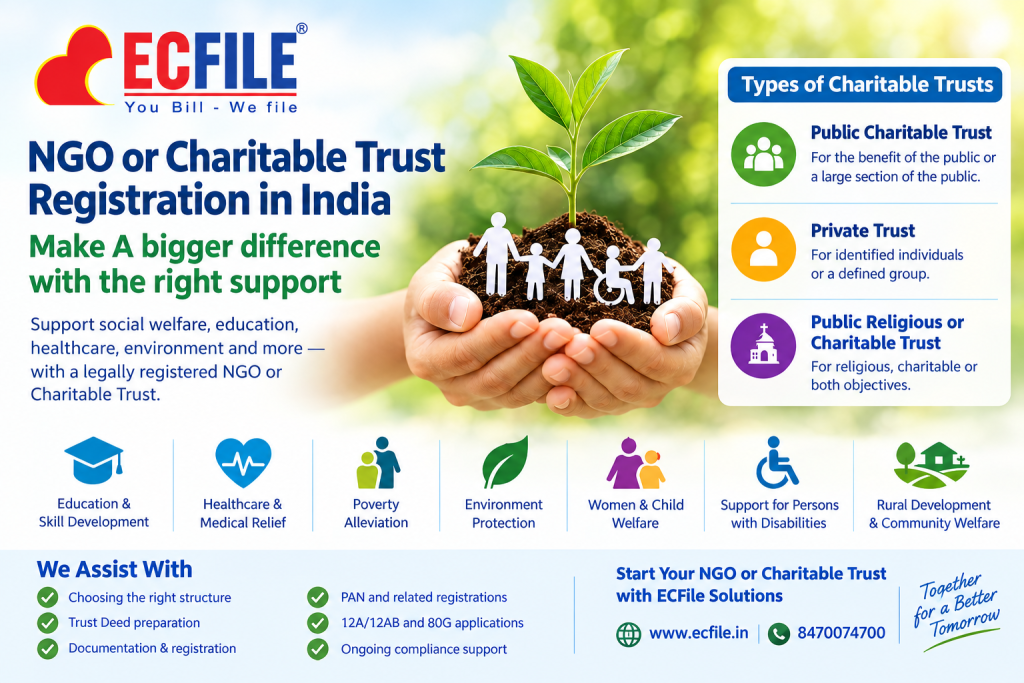
Types of Charitable Trusts in India
Charitable trusts can broadly be classified based on their beneficiaries and objectives.
1. Public Charitable Trust
A Public Charitable Trust is established for the benefit of the public or a sufficiently large section of the public. Common objectives include:
- Education and skill development
- Medical relief and healthcare
- Poverty alleviation
- Women and child welfare
- Rural development
- Environmental protection
- Support for persons with disabilities
- Other public welfare activities
Public trusts are commonly used by organisations carrying out charitable and social-welfare activities.
2. Private Trust
A Private Trust is generally created for the benefit of identified individuals or a defined group of beneficiaries rather than the public at large.
For example, a trust created to manage assets for particular family members would generally be considered a private trust.
The Indian Trusts Act, 1882 primarily deals with private trusts and trustees, while public or private religious or charitable endowments are treated separately under applicable laws.
3. Public Religious or Charitable Trust
A trust may also have religious, charitable, or both religious and charitable objectives. Examples include trusts established for:
- Running educational institutions
- Hospitals and medical relief
- Relief of the poor
- Religious activities
- Community welfare
- Preservation of religious or cultural institutions
The tax treatment of such trusts depends on the applicable income-tax provisions and fulfilment of the required conditions.
Trust vs Society vs Section 8 Company
| Particular | Trust | Society | Section 8 Company |
| Main document | Trust Deed | MOA & Rules | MOA & AOA |
| Management | Trustees | Governing body | Board of Directors |
| Registration | Applicable State authority | Registrar of Societies | Ministry of Corporate Affairs |
| Suitable for | Charitable activities | Member/community-based activities | Structured non-profit organisations |
Documents Required
Common documents include:
- PAN and identity proof of Settlor and Trustees
- Address proof and photographs
- Registered office proof
- Ownership/rent documents and NOC, where applicable
- Proposed Trust name
- Charitable objectives
- Draft Trust Deed
Requirements may vary depending on the State and applicable laws.
Registration Process
The general process includes:
- Define the charitable objectives.
- Select a suitable Trust name.
- Prepare the Trust Deed.
- Execute and register the Deed with the appropriate authority.
- Obtain PAN and complete other applicable registrations.
12A/12AB and 80G
Trust registration is different from 12A/12AB and 80G income-tax registrations.
- 12A/12AB: Relevant for claiming tax exemption on eligible charitable income, subject to applicable conditions.
- 80G: Eligible approval can allow donors to claim deductions on qualifying donations, subject to applicable rules.
Therefore, Trust registration alone does not automatically provide 12A/12AB or 80G benefits.
Why Professional Assistance Helps
Professional support can help with:
- Selecting the appropriate structure
- Drafting charitable objects and the Trust Deed
- Preparing documents
- Registration assistance
- PAN and related registrations
- 12A/12AB and 80G applications
- Ongoing compliance guidance
Start Your NGO or Charitable Trust with ECFile Solutions
ECFile Solutions provides assistance with NGO and Charitable Trust registration, documentation and related compliance requirements.
🌐 www.ecfile.in
📞 8470074700
Frequently Asked Questions
Is an NGO the same as a Trust?
No. NGO is a broad term. A Trust, Society or Section 8 Company can be used as an NGO’s legal structure.
Can a Trust receive donations?
Yes, subject to applicable legal, tax and regulatory requirements.
Is Trust registration enough for 80G?
No. 80G is a separate approval subject to applicable conditions.
Can a Trust conduct educational or medical activities?
Yes, if these activities are covered by its charitable objects and comply with applicable laws.
Which is better: Trust, Society or Section 8 Company?
There is no single suitable structure for every organisation. The choice depends on the proposed activities, founders, governance and long-term objectives.