
Tax Audit vs Statutory Audit: Understanding the Key Differences
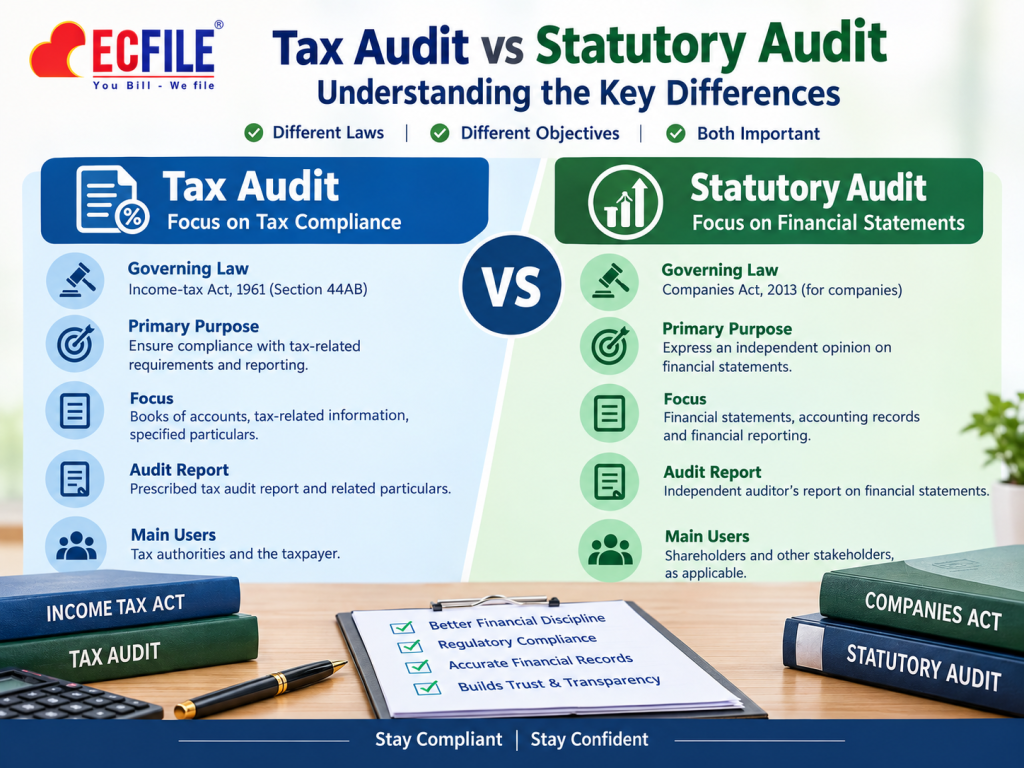
Audits play an important role in ensuring financial transparency, regulatory compliance, and accuracy in business records. In India, two commonly discussed types of audits are Tax Audit and Statutory Audit.
Although both involve the examination of financial records by a Chartered Accountant, they serve different purposes and are conducted under different laws. Understanding the difference between a Tax Audit and a Statutory Audit can help businesses comply with their legal and financial obligations more effectively.
What is a Tax Audit?
A Tax Audit is an examination of a taxpayer’s books of accounts and related records to determine whether they have complied with the requirements of the Income-tax Act.
In India, Tax Audit provisions are primarily governed by Section 44AB of the Income-tax Act, 1961. Where the applicable conditions are satisfied, the taxpayer is required to get their accounts audited by a Chartered Accountant and furnish the prescribed audit report.
The primary objective of a Tax Audit is to help ensure that income, expenses, deductions, and other relevant information reported for income-tax purposes are properly supported by the books and records.
Key objectives of a Tax Audit
A Tax Audit generally aims to:
- Verify whether the books of accounts have been properly maintained.
- Check the accuracy and completeness of financial information relevant to taxation.
- Report specified particulars required under the Income-tax Act.
- Identify tax-related discrepancies and non-compliance.
- Provide information that assists the Income Tax Department in assessing the taxpayer’s income correctly.
What is a Statutory Audit?
A Statutory Audit is an audit that is required by law. For companies in India, statutory audit requirements are primarily governed by the Companies Act, 2013.
The statutory auditor examines the company’s financial statements and expresses an independent opinion on whether they present a true and fair view in accordance with the applicable financial reporting framework and legal requirements.
Unlike a Tax Audit, which is primarily concerned with tax compliance and reporting requirements, a Statutory Audit focuses on the financial statements and the company’s financial reporting.
Key objectives of a Statutory Audit
A Statutory Audit generally aims to:
- Examine the company’s financial statements.
- Verify accounting records and supporting documents.
- Assess whether the financial statements give a true and fair view.
- Identify material misstatements and areas requiring attention.
- Provide an independent audit opinion to the stakeholders.
Tax Audit vs Statutory Audit: Key Differences
While both audits involve examination of financial records, there are several important differences between them.
| Basis | Tax Audit | Statutory Audit |
|---|---|---|
| Primary purpose | To ensure compliance with specified tax-related requirements | To express an opinion on financial statements |
| Main law | Income-tax Act, 1961 | Companies Act, 2013, for companies |
| Applicability | Applies when the conditions prescribed under tax law are met | Applies where the relevant statute requires an audit |
| Focus | Tax-related information, books and specified particulars | Financial statements, accounting records and financial reporting |
| Audit report | Prescribed tax audit report and related particulars | Independent auditor’s report on financial statements |
| Users | Primarily tax authorities and the taxpayer | Shareholders and other stakeholders, as applicable |
| Scope | Focused on matters relevant to income-tax compliance | Generally covers the financial statements and related audit requirements |
| Objective | Facilitate compliance with tax laws and reporting requirements | Provide an independent opinion on the financial statements |
| Applicability to entities | Can apply to eligible businesses and professions meeting specified conditions | Depends on the governing statute and nature of the entity |
Is Tax Audit the Same as Statutory Audit?
No. Tax Audit and Statutory Audit are separate audits with different objectives and legal requirements.
A business may be required to undergo both audits. For example, a company may be subject to statutory audit under the Companies Act and may also fall within the provisions requiring a tax audit under the Income-tax Act.
The fact that the same Chartered Accountant or audit firm may perform both audits does not make them the same audit. The auditor has to address the requirements applicable to each audit separately.
Difference in the Scope of Audit
The scope of a Tax Audit is closely connected with tax compliance. The auditor examines books and records and reports the particulars required under the Income-tax Act and applicable rules.
A Statutory Audit, on the other hand, is primarily concerned with the financial statements and whether they present a true and fair view in accordance with the applicable accounting and legal framework.
Therefore, a statutory audit may identify accounting or financial reporting matters that are not necessarily the focus of a tax audit. Similarly, a tax audit may require reporting of tax-specific particulars that are not the primary focus of a statutory audit.
Can One Audit Replace the Other?
Generally, no.
The requirements for Tax Audit and Statutory Audit arise from different legal provisions. Compliance with one does not automatically mean that the requirements of the other have been fulfilled.
Businesses should therefore determine separately whether they are required to undergo:
- A Statutory Audit;
- A Tax Audit; or
- Both.
The applicable requirements can depend on factors such as the nature of the entity, turnover or gross receipts, business or professional activity, and other conditions prescribed under the relevant law.
Why Are Both Audits Important?
Both audits contribute to better financial discipline, but from different perspectives.
A Tax Audit helps ensure that relevant tax information is properly reported and that the taxpayer complies with applicable tax requirements.
A Statutory Audit provides independent assurance regarding the financial statements and supports transparency for shareholders and other stakeholders.
Maintaining accurate books of accounts, supporting documentation, internal controls, and proper accounting records can make both audit processes more efficient.
Conclusion
Tax Audit and Statutory Audit may appear similar because both involve the examination of financial records by an auditor, but their purpose, legal framework, scope, and reporting requirements are different.
A Tax Audit primarily deals with compliance and reporting requirements under income-tax law, whereas a Statutory Audit focuses on the audit of financial statements as required by the applicable statute.
For businesses, understanding these differences is important not only for compliance but also for maintaining proper financial records and avoiding unnecessary complications during the audit process.
Note: Tax and audit requirements can change through amendments, notifications, and applicable rules. Businesses should verify the requirements applicable for the relevant financial year and entity type before relying on this article for compliance purposes.