
How to Check Whether Your Product Requires BIS Certification in India
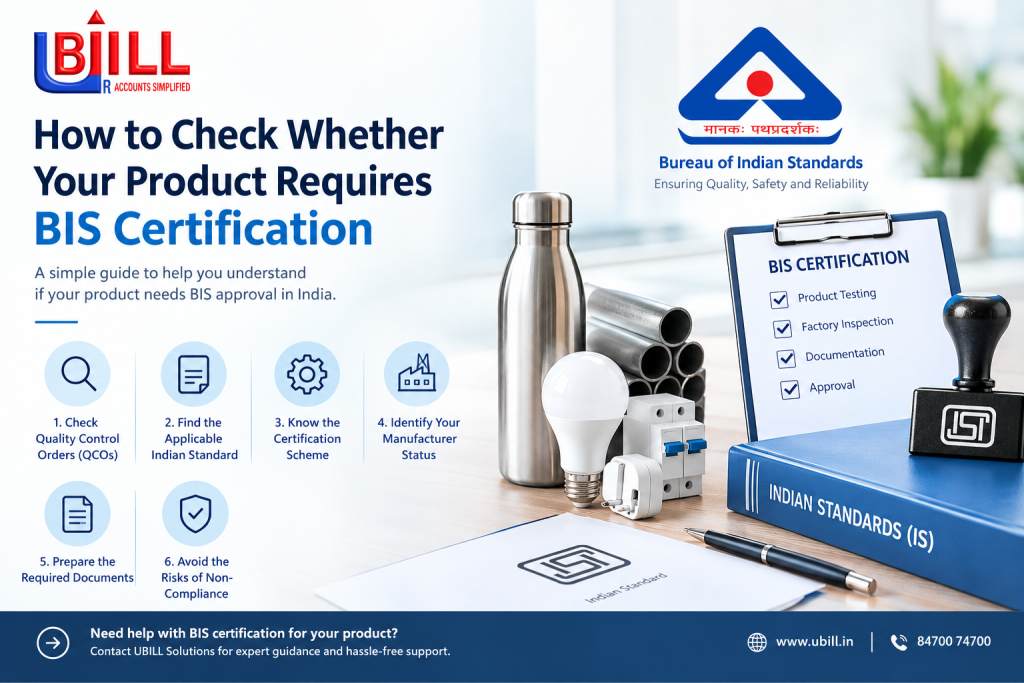
Introduction
If you are a manufacturer, importer, or business owner in India, understanding whether your product requires Bureau of Indian Standards (BIS) certification is essential before manufacturing, importing, distributing, or selling it in the Indian market.
BIS certification helps ensure that products meet applicable Indian Standards for quality, safety, performance, and reliability. While certification is voluntary for many products, it is mandatory for certain products notified by the Government of India under applicable Quality Control Orders (QCOs) and other regulations.
Selling a product that requires mandatory BIS certification without obtaining the necessary approval may result in regulatory action, penalties, or restrictions on its sale.
In this blog, ECFile Solutions explains how to check whether your product requires BIS certification in India.
1. Understand What BIS Certification Is
The Bureau of Indian Standards (BIS) is India’s national standards body. It develops Indian Standards and operates product certification schemes to help ensure that products comply with applicable requirements.
Depending on the product category and applicable regulations, BIS certification may involve product testing, factory inspection, documentation, and approval from BIS.
Common BIS certification routes include:
- ISI Mark Certification: Applicable to products covered under the relevant BIS product certification scheme, including products subject to mandatory certification.
- Compulsory Registration Scheme (CRS): Covers notified product categories, including certain electronic and IT products.
- Foreign Manufacturers Certification Scheme (FMCS): Provides a route for eligible foreign manufacturers to obtain BIS licences for products covered under the applicable scheme.
The correct certification route depends on the product, the applicable Indian Standard, and the relevant regulatory notification.
2. Check Whether Your Product Is Covered Under a Quality Control Order (QCO)
One of the most important steps is to determine whether your product is covered under a Quality Control Order issued by the relevant Indian government ministry or department.
A QCO may require a product to conform to a specified Indian Standard and obtain BIS certification before it can be manufactured, imported, distributed, or sold in India, subject to the order’s scope, effective date, and exemptions.
How to check:
- Visit the official BIS website at https://www.bis.gov.in/.
- Check the applicable product certification information and relevant Indian Standards.
- Review the latest Quality Control Orders issued by the concerned ministry.
- Verify the product description, applicable standard, implementation date, and any exemptions.
- Confirm whether the requirement applies to your product and business activity.
Do not rely solely on a product’s name or general category. The exact product specification and the scope of the relevant QCO are important.
3. Search the BIS Website for the Applicable Indian Standard
Every BIS-certified product is assessed against the requirements of an applicable Indian Standard (IS), where prescribed under the relevant certification scheme or regulation.
For example, different types of electrical appliances, steel products, pipes, household goods, and electronic equipment may be covered by different Indian Standards.
To identify the relevant standard:
- Search the BIS website for your product category.
- Check the product’s material, intended use, design, and technical specifications.
- Identify the applicable IS number and title.
- Verify whether the standard is linked to a mandatory certification requirement.
Finding an Indian Standard for your product does not automatically mean that BIS certification is mandatory. You must also verify the applicable scheme and regulatory requirements.
4. Check Whether Your Product Falls Under the BIS Compulsory Registration Scheme (CRS)
Certain electronic and information technology products fall under the BIS Compulsory Registration Scheme.
Depending on the applicable notification, products may include specified categories of electronic equipment, power supplies, batteries, and other notified goods.
If your product falls under CRS, you should verify:
- Whether the exact product category is covered.
- Which Indian Standard applies.
- Whether the requirement applies to your product model or family.
- What testing and registration requirements must be completed.
- Whether any exemptions or special provisions apply.
Manufacturers should confirm the applicable requirements before introducing a covered product into the Indian market.
5. Determine Whether You Are an Indian or Foreign Manufacturer
Your manufacturing location can influence the certification route and documentation required.
For Indian manufacturers: The applicable process may involve identifying the relevant Indian Standard, arranging product testing through an appropriate laboratory, preparing factory and quality-control documentation, and completing the applicable BIS application and inspection requirements.
For foreign manufacturers: Products covered by the relevant certification scheme may require approval under the Foreign Manufacturers Certification Scheme or another applicable BIS route. The foreign manufacturing unit must satisfy the requirements of the relevant scheme.
Importers should verify compliance before importing products that are subject to mandatory BIS requirements. A foreign product certificate or a test report alone should not be assumed to replace the required Indian approval.
6. Identify the Documents and Product Details Required
Once you establish that your product requires BIS certification, identify the documents and technical details needed for the applicable scheme.
Depending on the product and certification route, these may include:
- Company registration and manufacturing-unit details.
- Product specifications, drawings, and technical information.
- Details of the applicable Indian Standard.
- Manufacturing process and quality-control information.
- Testing reports from an appropriate laboratory.
- Factory layout and inspection-related documents, where applicable.
- Trademark or brand details, where required.
- Authorisation and other scheme-specific documents.
The exact checklist varies by product and certification scheme. Confirm the latest requirements before submitting an application.
7. Understand the Consequences of Selling Products Without Mandatory BIS Certification
If a product is subject to mandatory BIS certification, manufacturing, importing, or selling it without the required approval may lead to legal and regulatory consequences.
Potential consequences may include:
- Restrictions on the sale or distribution of the product.
- Regulatory action under the applicable law or Quality Control Order.
- Financial penalties or other enforcement measures, where applicable.
- Delays in product launches and business operations.
- Additional costs associated with corrective action and compliance.
Businesses should verify the applicable requirements early to reduce the risk of non-compliance.
8. How ECFile Solutions Can Help With BIS Certification
Determining whether a product requires BIS certification can involve reviewing Indian Standards, Quality Control Orders, product specifications, and the applicable certification scheme.
ECFile Solutions provides consultancy support to businesses seeking assistance with regulatory compliance and product certification.
Our consultancy support can include:
- Product applicability checks: Assistance in identifying the relevant Indian Standard and assessing whether mandatory BIS certification may apply.
- Certification route guidance: Assistance in understanding the applicable BIS certification scheme.
- Documentation support: Guidance on preparing the documents required for the application.
- Application assistance: Support with the applicable filing and documentation process.
- Inspection and testing coordination: Assistance with understanding and coordinating relevant requirements, depending on the certification scheme.
- Compliance guidance: Support in understanding the requirements to be addressed before marketing a regulated product.
The applicable scope, testing requirements, government fees, timelines, and approval process depend on the product and the relevant BIS scheme.
Conclusion
Checking whether your product requires BIS certification is an important step before manufacturing, importing, or selling goods in India. Businesses should review the relevant Quality Control Orders, identify the applicable Indian Standard, determine the correct certification scheme, and confirm any exemptions or special conditions.
Taking the right steps at the beginning can help reduce compliance risks, avoid unnecessary delays, and support a smoother product launch.
Need assistance checking BIS certification requirements for your product?
Contact ECFile Solutions for professional consultancy support with BIS applicability checks, certification guidance, and documentation assistance.
Website: https://www.ecfile.in/
Contact: 84700 74700
Disclaimer: This article is for general informational purposes only. BIS requirements and Quality Control Orders may change. Always verify the latest applicable standards, notifications, exemptions, and implementation dates through official sources before making compliance decisions.