
EPF and ESIC Filing After Registration on the Shram Suvidha Portal – Updated Wage Limits 2026
Introduction
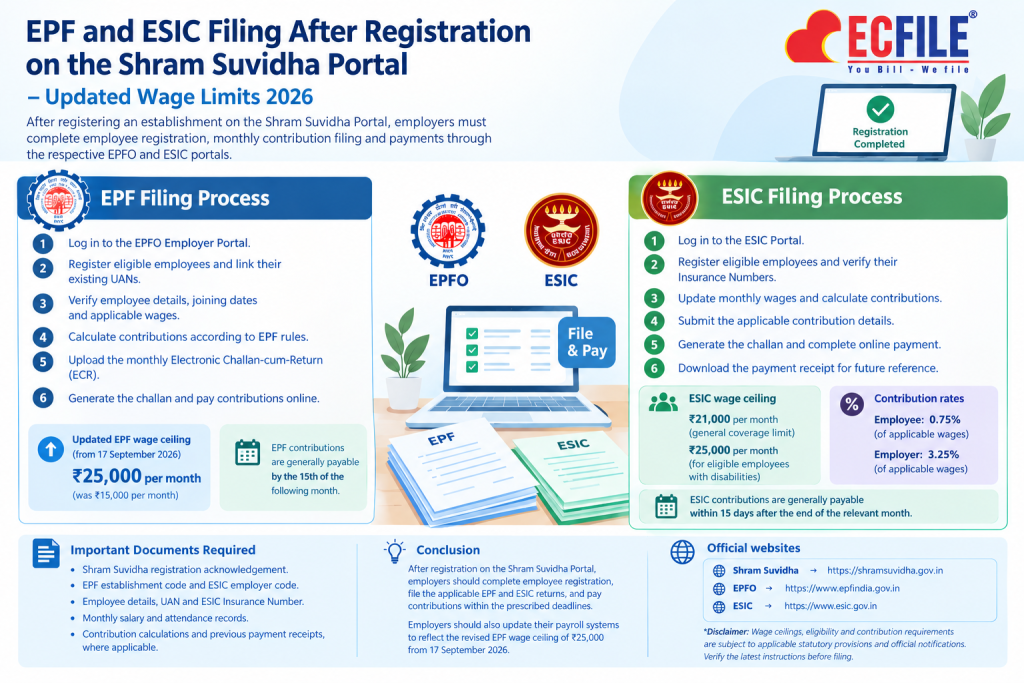
Registering your establishment on the Shram Suvidha Portal is an important step towards complying with applicable labour laws in India. However, registration is only the beginning. Employers must also complete employee enrolment, calculate monthly contributions, file the required returns, and pay contributions within the prescribed deadlines through the respective EPFO and ESIC portals.
Understanding the filing procedures, wage ceilings, contribution rates, and documentation requirements helps businesses maintain compliance and avoid unnecessary delays or penalties.
1. EPF Filing Process After Registration
The Employees’ Provident Fund (EPF) scheme helps employees build long-term retirement savings through contributions from both employees and employers.
Once the establishment is registered and the applicable EPF requirements are confirmed, employers generally need to follow these steps:
- Log in to the EPFO Employer Portal: Access the employer account using the establishment credentials.
- Register eligible employees: Add employee details and link existing Universal Account Numbers (UANs), wherever applicable.
- Verify employee information: Check joining dates, wages, and other relevant employment details.
- Calculate contributions: Determine employee and employer contributions according to the applicable EPF rules.
- Prepare and upload the ECR: Submit the monthly Electronic Challan-cum-Return (ECR) with the required employee and contribution details.
- Generate the challan and pay: Complete the contribution payment online and retain the payment receipt.
Updated EPF Wage Ceiling for 2026
The statutory wage ceiling for mandatory EPF membership is an important factor in determining employee eligibility. Any change to this limit must be supported by an applicable official notification.
Important: Before applying the stated revised ceiling of ₹25,000 per month from 17 September 2026, employers should verify the relevant government notification and its effective date. Until the change is officially confirmed, the existing statutory provisions and applicable EPF scheme rules should be followed.
EPF contributions are generally payable by the 15th of the following month.
2. ESIC Filing Process After Registration
The Employees’ State Insurance (ESI) scheme provides eligible employees with social security benefits, including medical care and certain cash benefits, subject to the applicable provisions.
Employers can generally complete the ESIC contribution process through the following steps:
- Log in to the ESIC Portal: Access the employer account.
- Register eligible employees: Add employee details and verify their ESIC Insurance Numbers.
- Update monthly wages: Record the applicable wage details for the contribution period.
- Calculate contributions: Apply the prescribed employee and employer contribution rates.
- Generate the challan: Review the contribution details and generate the payment challan.
- Pay and retain records: Complete the online payment and download the receipt for future reference.
ESIC Wage Ceiling and Contribution Rates
The general ESIC wage ceiling is ₹21,000 per month. A ceiling of ₹25,000 per month applies to eligible persons with disabilities, subject to the applicable provisions.
The standard ESIC contribution rates are:
- Employee contribution: 0.75% of applicable wages.
- Employer contribution: 3.25% of applicable wages.
ESIC contributions are generally payable within 15 days after the end of the relevant calendar month.
Employers should verify employee eligibility, applicable wage components, and the current statutory requirements before calculating contributions.
3. Documents Required for EPF and ESIC Filing
Keep the following documents and information ready to simplify monthly compliance:
- Shram Suvidha Portal registration acknowledgement.
- EPF establishment code and ESIC employer code, as applicable.
- Employee details, UANs, and ESIC Insurance Numbers.
- Monthly salary and attendance records.
- Employee joining and exit details, where applicable.
- Monthly contribution calculations and ECR details.
- Previous challans and payment receipts, where applicable.
Maintaining accurate payroll and employee records helps minimise filing errors and makes future verification easier.
4. Important Compliance Deadlines
Employers should monitor the following general payment deadlines:
| Compliance | General due date |
| EPF contribution payment | 15th of the following month |
| ESIC contribution payment | Within 15 days after the end of the calendar month |
These deadlines refer to the general contribution payment requirements. Employers should also check the applicable return-filing procedures, portal instructions, and any official extensions or changes.
5. Common Mistakes Employers Should Avoid
To maintain smooth EPF and ESIC compliance, employers should avoid:
- Incorrect employee details or UAN/Insurance Number information.
- Errors in wage and contribution calculations.
- Delayed challan payments.
- Failure to update employee joining or exit details.
- Missing payment receipts and payroll records.
- Applying wage ceilings without verifying the latest official notifications.
Regular payroll reconciliation and timely filing can help businesses reduce compliance risks.
Conclusion
Registration on the Shram Suvidha Portal is only the first step in establishing labour law compliance. Employers must also ensure that eligible employees are registered, monthly EPF and ESIC contributions are calculated correctly, required filings are completed, and payments are made within the prescribed deadlines.
Since wage ceilings and other statutory requirements may change, businesses should verify the latest official notifications before updating payroll systems or submitting contributions.
Need assistance with EPF and ESIC compliance?
ECFILE Solutions can help businesses understand applicable registration and compliance requirements and organise the documentation needed for their filings.
Visit www.ecfile.in to learn more about our compliance and registration services.
Disclaimer: This article is for general informational purposes only and does not constitute legal advice. Wage ceilings, eligibility criteria, contribution rates, and filing requirements are subject to applicable laws, schemes, and official notifications. Please verify the latest requirements with the relevant authorities before filing.